| NEONATAL PERIOD |
| From birth to approximately 2 weeks of age. |
| Starting at Birth: |
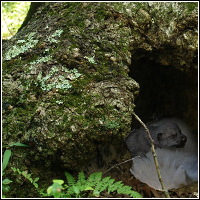 Approximately 1lb. (0.5 kg.), pups are born blind, deaf with their ears sealed against their heads, darkly-furred and with a "plugged" nose that has little, if any, sense of smell. They can whine and yelp, and are limited to a slow crawl; males gain around 3.3 lbs. and females 2.6 lbs. a week for the next 14 weeks. They are nursed 4-5 times a day. Born with only their undercoat and unable to regulate their own body temperature, they rely on close contact with their parent to keep warm. Approximately 1lb. (0.5 kg.), pups are born blind, deaf with their ears sealed against their heads, darkly-furred and with a "plugged" nose that has little, if any, sense of smell. They can whine and yelp, and are limited to a slow crawl; males gain around 3.3 lbs. and females 2.6 lbs. a week for the next 14 weeks. They are nursed 4-5 times a day. Born with only their undercoat and unable to regulate their own body temperature, they rely on close contact with their parent to keep warm.
Estimated human age: newborn to 2 months old. |
| TRANSITION PERIOD |
| From approximately 2 to 3 weeks of age. |
| Starting at 2 Weeks: |
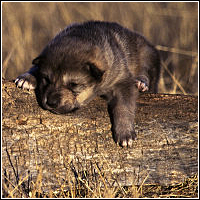 The pups' eyes open and are a shade of blue at 11-15 days but their vision is poor and they are still unable to perceive forms. Milk incisors are present, and they begin to stand, walk, growl, and chew along with attempting to communicate and "sing" with high-pitched howls and whines. While they are highly interactive with their siblings and parents, they still cannot hear their family in return. The pups' eyes open and are a shade of blue at 11-15 days but their vision is poor and they are still unable to perceive forms. Milk incisors are present, and they begin to stand, walk, growl, and chew along with attempting to communicate and "sing" with high-pitched howls and whines. While they are highly interactive with their siblings and parents, they still cannot hear their family in return.
Estimated human age: 2 to 4 months old. |
| SOCIALIZATION PERIOD |
| From approximately 3 to 10 weeks of age. |
| Starting at 3 Weeks: |
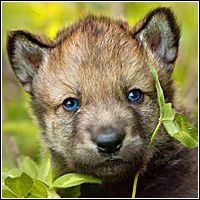 Pups begin appearing outside the den and are usually allowed to play near the entrance. Canines and premolar teeth are now present. Weight varies from 3 - 7 lbs. (1.4 - 3.2 kg.). Puppies have become extremely mobile and begin to understand the basics of the world around them. Parents and caretakers may find that they are constantly kept on their toes as they try to keep the puppies from venturing too far. As the pups' eyesight improves and starts to focus, they are able to recognize family, siblings, and other objects around them. While still unable to hear and therefor mimic sounds, they can now engage in "canonical babbling," or the repetition of syllables in a string (/ba ba ba ba/). Pups begin appearing outside the den and are usually allowed to play near the entrance. Canines and premolar teeth are now present. Weight varies from 3 - 7 lbs. (1.4 - 3.2 kg.). Puppies have become extremely mobile and begin to understand the basics of the world around them. Parents and caretakers may find that they are constantly kept on their toes as they try to keep the puppies from venturing too far. As the pups' eyesight improves and starts to focus, they are able to recognize family, siblings, and other objects around them. While still unable to hear and therefor mimic sounds, they can now engage in "canonical babbling," or the repetition of syllables in a string (/ba ba ba ba/).
Estimated human age: 4 to 8 months old. |
| Starting at 4 Weeks: |
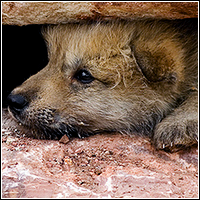 Ears raise, finally allowing for hearing. Pups now weigh 5-6 lbs.; the growth of adult hair around nose and eyes becomes apparent, and their high-pitched howls gain strength and volume. Mothers may now leave their dens for hours to hunt. Pups utilizing expressive and communicative gestures more fluently and intentionally, while play and dominance fights among siblings begin. Now 1 month old, puppies have fully entered their "toddler" stage physically. They are keen to pick up patterns in speech, sounds and words and may mimic them to practice social skills. By the end of this period they have memorized the sound of their parents' voices and can recognize and respond to their own name. Ears raise, finally allowing for hearing. Pups now weigh 5-6 lbs.; the growth of adult hair around nose and eyes becomes apparent, and their high-pitched howls gain strength and volume. Mothers may now leave their dens for hours to hunt. Pups utilizing expressive and communicative gestures more fluently and intentionally, while play and dominance fights among siblings begin. Now 1 month old, puppies have fully entered their "toddler" stage physically. They are keen to pick up patterns in speech, sounds and words and may mimic them to practice social skills. By the end of this period they have memorized the sound of their parents' voices and can recognize and respond to their own name.
Estimated human age: 8 to 12 months old. |
| Starting at 5 Weeks: |
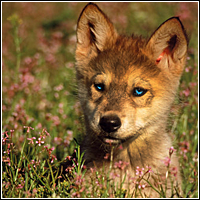 The gradual process of weaning begins and they can now follow adults for up to 1 mile from the den. With being allowed to accompany adults, learning continually advances with the aid of social interaction. By this point, most pups will have said their first meaningful word, and from then will only continue to expand their vocabulary. Simple commands and instruction can also be comprehended (ie. "Stop that," "No," "Come here.") and are still subject to repetition by echolalia as an attempt to fully understand the word or phrase. The gradual process of weaning begins and they can now follow adults for up to 1 mile from the den. With being allowed to accompany adults, learning continually advances with the aid of social interaction. By this point, most pups will have said their first meaningful word, and from then will only continue to expand their vocabulary. Simple commands and instruction can also be comprehended (ie. "Stop that," "No," "Come here.") and are still subject to repetition by echolalia as an attempt to fully understand the word or phrase.
Estimated human age: 12 to 16 months old. |
| Starting at 8 Weeks: |
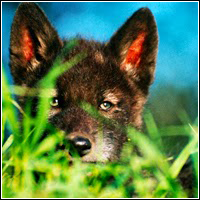 Pups sport a disproportional large head and feet as their skeleton grows towards its adult form. Eyes begin to gradually change from blue to their adult colors, commonly a yellow-gold. Puppies weigh about 20-30 lbs. (9-14 kg.) and may start to eat small bits of regurgitated meat. At this milestone, they begin to realize differences in their siblings (brothers vs. sisters) and can differentiate adults from children. They should have a vocabulary of at least 50 words, and be able to complete two-word sentences (ie. "I eat" or "I go"). They can also understand and follow more complex commands (ie. "Get your toy," "Go to your sister," "Leave it alone."). Pups sport a disproportional large head and feet as their skeleton grows towards its adult form. Eyes begin to gradually change from blue to their adult colors, commonly a yellow-gold. Puppies weigh about 20-30 lbs. (9-14 kg.) and may start to eat small bits of regurgitated meat. At this milestone, they begin to realize differences in their siblings (brothers vs. sisters) and can differentiate adults from children. They should have a vocabulary of at least 50 words, and be able to complete two-word sentences (ie. "I eat" or "I go"). They can also understand and follow more complex commands (ie. "Get your toy," "Go to your sister," "Leave it alone.").
Estimated human age: 16 to 20 months old. |
| JUVENILE PERIOD |
| From approximately 10 weeks up to 12 months of age. |
| Starting at 10 Weeks: |
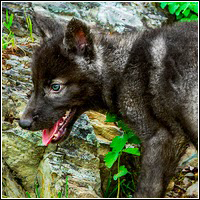 Parents abandon the birthing den and move the pups to a main rendezvous site, typically their pack's communal den. These sites can also be in other high-traffic areas for the pack, and there are sometimes as many as 3-4 altogether. Weaning completes, and they can now feed on food that an adult provides. Adult hairs become fully apparent on the head and face. Social and pack norms are picked up on as pups are exposed to them. Most puppies are highly curious and may persistently ask questions in order to understand what they might not know. Their vocabulary might now consist of roughly 200-300 words, including some made-up ones (ie. "mouses," "birdses," "crovens," "breaked," and "hitted.") and combined phrases (ie. "Whassat?" and "I dunno."). Parents abandon the birthing den and move the pups to a main rendezvous site, typically their pack's communal den. These sites can also be in other high-traffic areas for the pack, and there are sometimes as many as 3-4 altogether. Weaning completes, and they can now feed on food that an adult provides. Adult hairs become fully apparent on the head and face. Social and pack norms are picked up on as pups are exposed to them. Most puppies are highly curious and may persistently ask questions in order to understand what they might not know. Their vocabulary might now consist of roughly 200-300 words, including some made-up ones (ie. "mouses," "birdses," "crovens," "breaked," and "hitted.") and combined phrases (ie. "Whassat?" and "I dunno.").
Estimated human age: 20 to 24 months old. |
| Starting at 12 Weeks: |
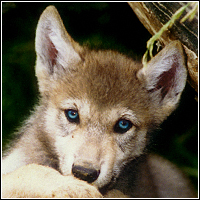 Pups begin to accompany adults on hunts to observe for partial durations and are capable of returning to the pack den on their own. Vocabulary at this point should have skyrocketed to about a thousand words. Puppies are capable of repeating four-syllable words, having brief back-and-forth conversations, and parroting what adults say in their midst, though they may still struggle to pronounce certain consonants. They are also able to grasp the concept of time (ie. morning, day, evening, night, today, tomorrow). Pups begin to accompany adults on hunts to observe for partial durations and are capable of returning to the pack den on their own. Vocabulary at this point should have skyrocketed to about a thousand words. Puppies are capable of repeating four-syllable words, having brief back-and-forth conversations, and parroting what adults say in their midst, though they may still struggle to pronounce certain consonants. They are also able to grasp the concept of time (ie. morning, day, evening, night, today, tomorrow).
Estimated human age: 2 to 3 years old. |
| Starting at 14 Weeks: |
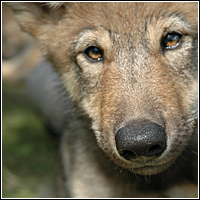 By the time puppies are 3.5 months (14 weeks) old, they are able to grasp more abstract words (ie. hope, dream, guess, pretend, believe), solve simple problems, and are competent enough to understand the concept of talking and listening, and joining a conversation while making relevant points. Milk teeth begin to fall and are replaced by adult teeth, their winter under coat starts to grow in, and adult fur coloring overall is becoming noticeable. By the time puppies are 3.5 months (14 weeks) old, they are able to grasp more abstract words (ie. hope, dream, guess, pretend, believe), solve simple problems, and are competent enough to understand the concept of talking and listening, and joining a conversation while making relevant points. Milk teeth begin to fall and are replaced by adult teeth, their winter under coat starts to grow in, and adult fur coloring overall is becoming noticeable.
Estimated human age: 3 to 5 years old. |
| Starting at 4 Months: |
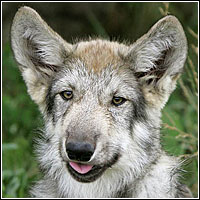 Pups are now able to accompany adults to observe for a full hunting trip. If their eyes have not changed from their original "puppy blue" shade, they will remain blue from this time forward. A period of rapid growth begins; pups gain approximately 1.3 lbs per week for the next 2 months. Pups are now able to accompany adults to observe for a full hunting trip. If their eyes have not changed from their original "puppy blue" shade, they will remain blue from this time forward. A period of rapid growth begins; pups gain approximately 1.3 lbs per week for the next 2 months.
Estimated human age: 5 to 6 years old. |
| Starting at 6 Months: |
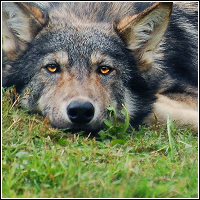 Pups now travel with the pack, and begin to actively hunt small prey on their own. At 6 months old, most pups weigh in at 30-80 lbs. (13.6 kg-36.3 kg.). Growth slows down, with males now gaining 0.4 lbs and females 0.07 lbs a week. They have largely grown into their oversized feet, ears and head and stand out far less amongst the pack, but are not yet full-sized and still have another 35-75 lbs. (15.9 kg-34 kg.) to go; skeletal growth and muscle gain continue steadily for the next six months. Puppies now fully understand, as well as utilize, even subtle non-verbal communication. If introduced to "animism" or "religion," at this stage they may have a mentally firm grasp on it; and, if acquainted with concepts such as the "sand wolf," monsters and ghosts, they may have shed their beliefs in them. They are capable of articulate speech and possess expansive vocabularies. This may also mark their first ventures in establishing independence, brandishing rebellious measures, and exploring the desire to establish their own truly unique identity. Pups now travel with the pack, and begin to actively hunt small prey on their own. At 6 months old, most pups weigh in at 30-80 lbs. (13.6 kg-36.3 kg.). Growth slows down, with males now gaining 0.4 lbs and females 0.07 lbs a week. They have largely grown into their oversized feet, ears and head and stand out far less amongst the pack, but are not yet full-sized and still have another 35-75 lbs. (15.9 kg-34 kg.) to go; skeletal growth and muscle gain continue steadily for the next six months. Puppies now fully understand, as well as utilize, even subtle non-verbal communication. If introduced to "animism" or "religion," at this stage they may have a mentally firm grasp on it; and, if acquainted with concepts such as the "sand wolf," monsters and ghosts, they may have shed their beliefs in them. They are capable of articulate speech and possess expansive vocabularies. This may also mark their first ventures in establishing independence, brandishing rebellious measures, and exploring the desire to establish their own truly unique identity.
Estimated human age: 6 to 7 years old. |
| Starting at 7 Months: |
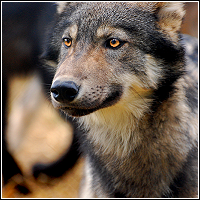 Those who are "late bloomers" may have just recently begun to truly grow into their disproportionate frames. Along with beginning to consider who they are, pups also become aware of how they're being perceived, and may begin to start feeling awkward in certain social situations. This is also the period in which puphood "crushes" may begin to occur, where pups start to favor and feel drawn to particular peers. Those who are "late bloomers" may have just recently begun to truly grow into their disproportionate frames. Along with beginning to consider who they are, pups also become aware of how they're being perceived, and may begin to start feeling awkward in certain social situations. This is also the period in which puphood "crushes" may begin to occur, where pups start to favor and feel drawn to particular peers.
Estimated human age: 7 to 9 years old. |
| Starting at 8 Months: |
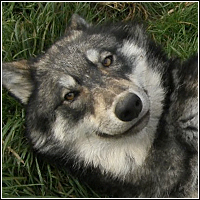 By 8 months a growing pup's body begins to internally change and adapt to accommodate sexuality. Their "voices" may continue to change, growing ever closer to what they will sound like as adults. Socialization with peers and autonomy become increasingly important to them. By 8 months a growing pup's body begins to internally change and adapt to accommodate sexuality. Their "voices" may continue to change, growing ever closer to what they will sound like as adults. Socialization with peers and autonomy become increasingly important to them.
Estimated human age: 9 to 11 years old. |
| Starting at 10 Months: |
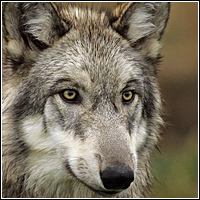 Voices may start to "break" or change abruptly in pitch while pups are speaking. "Crushes," if not a new experience altogether, may start to grow stronger and physical attraction might begin to factor in. They might have established their own views of right and wrong by now; moral codes presented at a younger age may be adhered and upheld, tweaked, or even cast away altogether. Voices may start to "break" or change abruptly in pitch while pups are speaking. "Crushes," if not a new experience altogether, may start to grow stronger and physical attraction might begin to factor in. They might have established their own views of right and wrong by now; moral codes presented at a younger age may be adhered and upheld, tweaked, or even cast away altogether.
Estimated human age: 11 to 13 years old. |
|




 Development
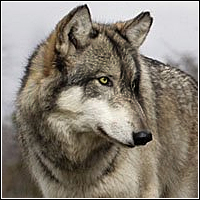 Pups reach their adult size (make sure the Physique part of their profile now reflects their build: Small, Medium, or Large) and skeletal growth stops. Muscle, and thus weight, gain may continue until around 22 months. Now considered 'yearlings' at this stage, their responsibilities grow along with the autonomy they gain. The heft of growing left to do now is emotional, experiential and intellectual (such as critical thinking). As they strive for maturity, their insides remain changing to accommodate their developing reproductive systems, and the shifting hormones often work against them. Many yearlings can experience strong and shifting emotions, impulsivity, and rebelliousness. Their priorities will likely shift, perhaps many times, and they often experience great self-discovery.
 At this age, most wolves reach sexual maturity and are now considered fully grown adults. Their fate is now in their own paws. From starting a family to exploring the world, the limits have fallen away! Many use this newfound freedom to continue learning about themselves and better discern their own place in life before tackling the larger, weightier goals such as, potentially, committing to a mate, taking on leadership, or becoming a parent— some don't! From here on out, their journey belongs to them.
 Very few physical changes happen from now until a wolf reaches their senior period. Our wolves, like humans, continue to grow and develop mentally over the years, but in uniquely individual ways that cannot be succinctly summarized. They continue to write their own stories.
 At this age, your character has reached a mid-point in their life, which many consider quite a significant marker. By this stage wolves often have begun reflecting back on their lives, and really start to consider just how much time they may (or may not) have left. Did they, or are they on track to, meet the ambitions of their younger years? Have they made choices they deeply regret, perhaps which could even still be made right? Are they exactly where they are meant to be, happy and whole? Some may decide it's time again for changes.
 Advancing in age, wolves at this stage may have seen it all. Their bodies are likely beginning to decline noticeably, from achy joints to weakening senses. Some may still have years ahead of them, but many pass around this age as well. Much of it depends on how well taken care of a wolf was throughout their life. Even the most pampered will still see gray hairs and softening physiques. At this point of life, wolves are at their last call for achieving, revenging, guiding, remedying, securing, and any other matters important to them. It truly is now or never.
 While wolves on RoW have yet to mature beyond this significant and distinguished age, it still is plausible given that your wolf has been well taken care of through the years. Their 'senior citizen' status still comes with all sorts of interesting development if it hasn't happened already - confusion, disorientation, forgetfulness, activity changes, increased sensitivity, impaired ability to carry out tasks, sleeping during the day, grooming and eating less, loss of hearing, increased anxiety levels, development of arthritis (especially in larger species), and being unable to navigate around or over obstacles. Younger pack members might take it upon themselves to help look after and care for them (just as they probably had for them when they were growing up!).